
Marketing Hotline:
(+86)0532-88988868
(+86)0532-88988868
The water resistivity from a two-stage RO + EDI setup can reach over 15 MΩ·cm; after further polishing mixed bed and end-point ultrapure water treatment, it can reach 18.2 MΩ·cm. Behind these numbers is a four-step process relay, not the spec of a single piece of equipment.
When asked, "How high can the water resistivity get with a two-stage RO plus EDI ultrapure water system?" the answer isn’t just "18.2." 18.2 MΩ·cm is the semiconductor industry's standard for ultrapure water quality, appearing at the very end of the whole process; in the middle stages, the usual range for the RO + EDI section is above 15 MΩ·cm. Between these two numbers lie the four stages—RO stage 1, RO stage 2, EDI, and final polishing—each handling its share of the desalination task. Breaking them down shows where you need to focus your efforts.
01 First, let's bust a myth: resistivity isn't a parameter of the reverse osmosis unit
A common saying goes, 'I went through EDI, so the water resistivity became 18.' This sentence credits the last piece of equipment, but desalination is like a relay race—each stage only removes part of the dissolved solids from the water and leaves the rest for the next stage.
The technical specs for our reverse osmosis host are: removing over 95% of dissolved solids in water, over 99% of organics and colloids, and almost 100% of bacteria, with the membrane element generally lasting 3–5 years. This is the desalination level for the entire host, but the evaluation indicators for the host are desalination rate and water output, not resistivity—resistivity only comes up later in the ion exchange and polishing stages. Conversely, if an earlier stage isn’t done right, like if hardness isn’t reduced which leads to scaling on the concentrate side, or residual chlorine damages the membrane, the load on the subsequent EDI will multiply, and the water resistivity will drop accordingly.
So to judge a system's resistance capability, you should look at whether the chain's division of labor is reasonable, not how many pieces of equipment there are.
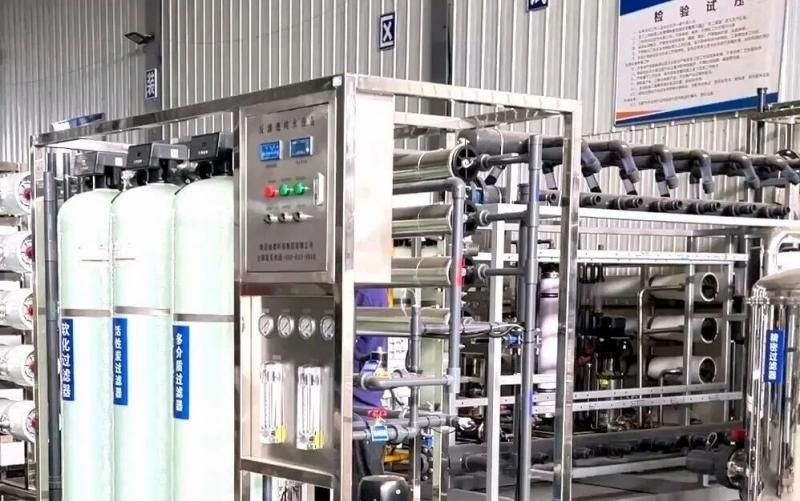
Pre-treatment unit: softening filter, activated carbon filter, multimedia filter, and precision filter are arranged in series, with functional labels hanging on the pipelines.
02 Second Part: What are the responsibilities of Level 1 RO and Level 2 RO
Two-stage reverse osmosis isn’t just about connecting two identical machines. The first-stage RO handles the raw water, and under brackish water c
onditions, the recovery rate is generally 65%–80%, over 60% for high-concentration brackish water. It takes care of most of the dissolved solids removal and also sets the stage for the water that goes into the EDI later.
The second-stage RO takes in the first-stage freshwater. By this time, the salinity of the incoming water has already dropped, so the second stage can continue reducing salt at a lower load, and the water quality matches better with the subsequent demineralization stage. The point of the second stage is to give the EDI a more suitable feedwater, not just to add another layer of the same equipment—water that’s 95% desalinated from the first stage going straight into the EDI behaves differently in terms of operational stability and output resistivity compared to water that’s gone through two stages first.
Here's another trade-off that's easy to overlook: recovery rate and scaling on the brine side are at odds. If you push the recovery rate up, you'll get more water, but the brine also gets more concentrated, which increases the tendency for scaling. Whether to go for two stages and what recovery rate to set should be calculated together with the feedwater salinity and concentration factor.
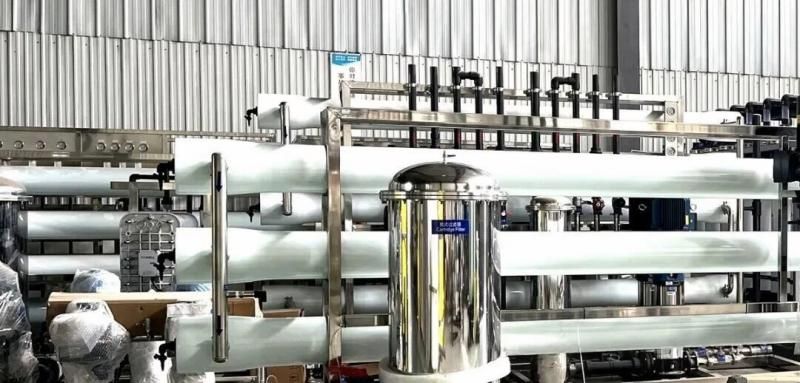
In the workshop, the reverse osmosis membrane housings are arranged in horizontal rows, with stainless steel piping connecting the front and back of the housings, and a filter riser in the middle.
03 Third paragraph: EDI This part pushes the number up to 15
EDI is continuous electric deionization; it moves ions using a DC electric field and doesn’t rely on regenerating solutions. Technically, it can reach a salt removal rate of over 99%, and when combined with RO, the produced water can have a resistivity of over 15 MΩ·cm. The concentrated water can be recycled back into the RO system, achieving an overall recovery rate of 90%–95%.
This is where EDI's weakness lies: it's sensitive to the quality of the incoming water. If the pretreatment doesn't bring hardness, residual chlorine, and SDI down to the specified range, EDI's desalination efficiency will take a hit, and the output water resistivity won't reach the rated value. That's also why online monitoring points like conductivity meters and pressure gauges are usually not optional.
04 Paragraph 4: Polishing mixed bed and the 18 and 18.2 of ultrapure water endpoints
After RO EDI, if you want to go even higher, it relies on the polishing stage. The caliber of the polishing mixed bed produces water at 18 MΩ·cm or higher, and it's a single-use mixed bed, used at the end of the process. The 18.2 MΩ·cm level corresponds to the ultrapure water quality standard for the electronics and semiconductor industry, which requires a whole set of end-stage equipment after the polishing stage, including a UV sterilizer, polishing resin, and microfiltration filter. The cost is mentioned elsewhere: mixed bed resin can't be regenerated, it's single-use, so operating costs are relatively high, while initial investment is relatively low.
It's worth noting that the common full ultra-pure water process in the industry doesn't just stop at EDI; instead, it's: pre-treated water → booster pump → reverse osmosis main unit → booster pump → EDI or mixed bed → pure water tank → pure water pump → UV sterilizer → polishing resin → microfiltration → ultra-pure water. The UV sterilizer targets microorganisms, while the polishing resin and microfiltration catch any remaining ions and particles at the end. These stages have different tasks from the previous desalination ones, so it's easier to think of the whole line as 'desalination first, polishing later.'
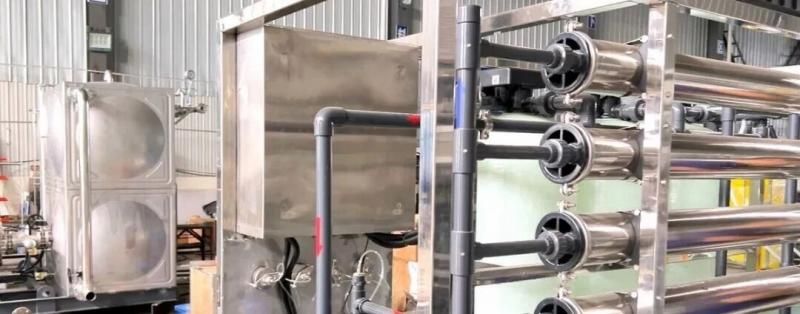
The membrane housing connection section on the stainless steel pipeline has end caps and pipe fittings arranged in groups, forming the connection channels for product water and concentrate.
Quick Reference: Comparison Table of Each Process Stage and Resistivity Caliber
Process section | Main task of this section | Writable Protocol Resistivity Caliber |
RO Level 1 | Removes most dissolved solids, organics, colloids, and bacteria; recovery rate for brackish water is 65%–80%, and over 60% for high-concentration brackish water. | Assess based on desalination rate and water output, not on resistivity. |
RO Level 2 | Use first-grade freshwater as the feed water for continued desalination, providing qualified feed water for EDI | The assessment indicators are both desalination rate and water output. |
EDI | Continuous electric desalination, desalination rate over 99%; concentrated water can be returned to RO, with an overall recovery rate of 90%–95% | Above 15 MΩ·cm |
Polishing mixed bed | Final polishing desalination; the resin can't be regenerated, so the operating costs are relatively high | Above 18 MΩ·cm |
Ultrapure water terminal | UV sterilizer, polishing resin, microfiltration filter; the polishing resin catches any leftover ions at the end, and the microfilter blocks particles | Up to 18.2 MΩ·cm, meeting the ultrapure water standards for the electronics and semiconductor industry |
Q&A Four Common Questions from Customers
Q1: You said it can reach 18.2, is that something that can be measured on the machine before it leaves the factory?
A: No, that’s not the factory value of a single unit. 18.2 MΩ·cm refers to the water quality produced after the whole ultrapure water system is running, and it depends on the raw water quality, each section's configuration, and operating parameters. Before leaving the factory, we complete the PLC program, instrument calibration, and leak tests of the whole water circuit; the resistivity value only becomes meaningful when running continuously on-site with the actual water quality. When writing a technical agreement, it’s recommended to list the resistivity range for each section separately, rather than just stating a single maximum value.
Q2: The raw water quality is average. Would adding a second stage be a waste?
A: It depends on your goal. If the raw water has low salt content and the required target resistivity isn’t high, a single-stage RO plus EDI is already enough. Adding a second stage would just mean more equipment and energy consumption. On the other hand, if the target is above 15 MΩ·cm and the raw water isn’t low in salts, the second stage can really help lighten the load on the EDI. The judgment should be based on the full set of raw water data and the target resistivity, not the water output. Send over these two sets of data, and we can calculate it for you step by step.
Q3: Can we choose just one between EDI and a polishing mixed bed?
A: They solve different problems. EDI works continuously without the need for regenerant and produces water with a resistivity above 15 MΩ·cm. A polishing mixed bed is for final purification, producing water of 18 MΩ·cm or higher, but the resin can't be regenerated and needs to be replaced—it's a one-time consumable. The usual setup is to use both in series: EDI handles the main demineralization, and the mixed bed or polishing resin takes care of the final polish. You only consider skipping the polishing stage if the end water quality requirements aren't high.
Q4: If we set the recovery rate a bit higher, will the water output go up?
A: The water output will indeed increase, but the concentration on the brine side also rises, which means scaling tendency goes up as well. If the recovery rate is set high, the earlier softening and iron/manganese removal stages will face more pressure, and both operating costs and membrane replacement frequency will increase. For brackish water conditions, we usually go for 65%–80%. For high-concentration brackish water, it’s over 60%. The exact setting depends on the source water salinity and concentration factor.
Summary Key Points Review
Four key points: Resistivity is the result of the entire chain. The desalination capability of the reverse osmosis (RO) main unit is over 95% for dissolved solids, over 99% for organics and colloids, and almost 100% for bacteria. The main unit is evaluated based on desalination rate and water output, while resistivity is determined in the later stages. The value of two-stage setups is in reducing the load on EDI—stage two continues desalting the freshwater from stage one while balancing recovery rate against scaling on the concentrate side. EDI can bring resistivity above 15 MΩ·cm, with a desalination rate over 99%, and the concentrate can be recycled back to the RO system to achieve an overall recovery rate of 90%–95%. 18.2 MΩ·cm water is considered ultra-pure at the endpoint; mixed bed water at 18 MΩ·cm or above, with non-regenerable resin and relatively high operating costs, meets the ultra-pure water standard for the electronics and semiconductor industry.