
Marketing Hotline:
(+86)0532-88988868
(+86)0532-88988868
If a reverse osmosis membrane had a 'work diary,' a day in its life would probably go something like this: continuously blocking salts, organic matter, and microbes in the water, letting clean water molecules pass through, and leaving the contaminants to be discharged on the brine side.
So, how much water can a single RO membrane process in a day? The answer isn’t a fixed number; it depends on the membrane element’s specifications, operating conditions, and feed water quality.
01 A membrane’s standard 'workload'

How much water can a standard membrane produce under a single pass?
Let's first look at the data under the industry's standard test conditions.
The 8040 membrane element (8 inches in diameter and 40 inches in length) produces about 40 m³/d (around 10,500 GPD) per unit under standard test conditions. The specifications vary slightly among different manufacturers, but most fall within the 36–44 m³/d range.
The 4040 membrane element (4 inches in diameter) produces much less water, about 3,000 GPD (around 11.4 m³/d) per unit. Some low-pressure 4040 models can produce about 8.5 m³/d.
To put it in simpler terms: one 8040 membrane element can produce enough purified water in a day to meet the daily needs of about 200 households.
02 Variables in the 'Work Diary'

But 'standard conditions' are just lab data. In real operation, the water production of the membrane is affected by many factors, with two being the most critical.
The 'primary driver' of water production
First, the feed water pressure. Pressure is the direct force that drives water molecules through the membrane. Research data shows that under ultra-low-pressure RO membrane operation, the factors affecting water production are ranked in strength as follows: feed water pressure (0.961) > temperature (0.583) > feed water salt concentration (-0.475) > recovery rate (-0.110). The impact of feed water pressure on water production is the most significant—the higher the pressure, the higher the water output.
The 'hidden variable' of water production
Second, the temperature of incoming water. The effect of temperature on water production is also significant. For every 1°C increase in water temperature, the membrane flux increases by about 3%, a rule widely cited in the industry. This means that the same membrane can produce more than 40% more water at 25°C in summer compared to 10°C in winter. When the temperature drops, water molecules become more viscous and their diffusion slows down, which leads to lower water output.
In other words, the 'workload' of a membrane in summer and winter could differ by nearly half.
03 'Overload' in Special Conditions
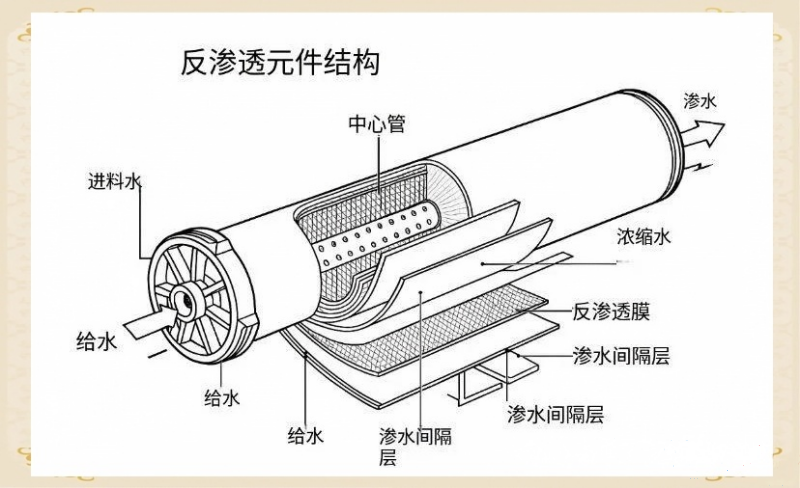
In certain special applications, the water output of the membrane elements can vary significantly.
Seawater Desalination vs Low-Salinity Water Source
Take seawater desalination as an example: when the feedwater TDS is as high as 55,000 mg/L, the membrane elements need to operate under extremely high pressure. Jinyu Membrane Technology's seawater desalination-specific membranes can produce up to 12 m³/h per membrane (under TDS 55,000 mg/L conditions), with a 99.85% desalination rate, chlorine resistance increased fivefold, and they've already completed a 10,000-ton pilot test.
In low-salinity water sources, low-pressure and ultra-low-pressure membranes have higher designed flux and stronger treatment capacity per membrane area, so the actual water output of a single membrane is noticeably higher than the values under standard conditions.
04 isn't 'the more, the better'
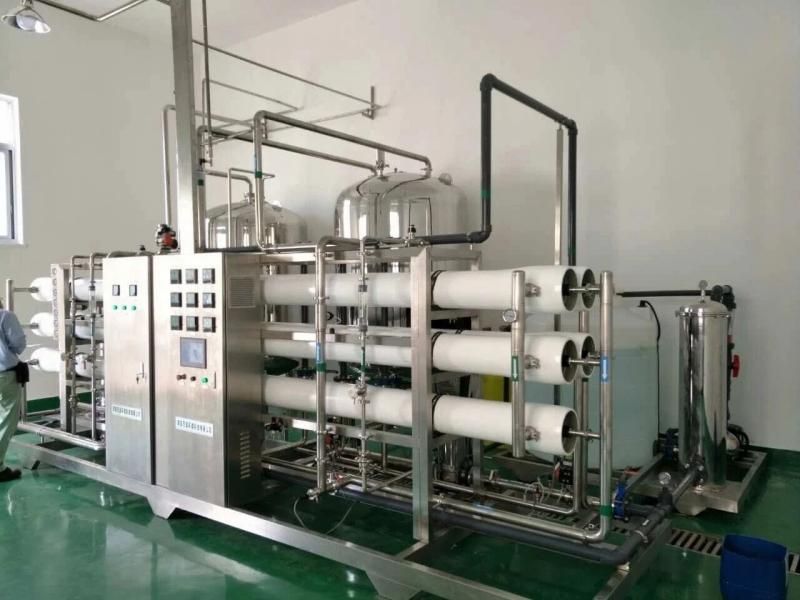
The amount of water a membrane can process in a day isn't always better the bigger it is. The water output is limited by the membrane's designed flux—the amount of water it can treat per unit area in a given time. If you go for a high flux, you'll need less membrane area and the initial investment is lower, but the membrane will foul much faster, cleaning will be more frequent, and its lifespan will be shorter.
The flux of municipal sewage MBR membranes is usually 10-25 L/(m²·h), while for industrial wastewater, due to its complex quality, the flux should be reduced to 5-15 L/(m²·h). Keeping some room in the flux helps ensure a longer lifespan.
Summary
The 'one day’s work' of a reverse osmosis membrane isn’t just a simple number. It depends on:
1.The membrane element specification (8040 or 4040)
2.Feed water pressure (the higher the pressure, the more water it produces)
3.Feed water temperature (the higher the temperature, the higher the flux)
4. Feed water quality (the higher the salinity, the less water it produces)
Under standard conditions, a single 8040 membrane element produces about 40 m³ of water per day. In actual operation, this number can fluctuate depending on the conditions. Pick the right membrane and use it correctly—so every membrane can run at its 'best working condition'.
Attachment: Quick Reference for Water Output of Membrane Elements of Different Specifications
| Specifications | Standard Water Output | Applicable Scenarios |
| 4040 | About 8.5-11.4 m³/day | Small to medium-sized system |
| 8040 | About 36-44 m³/d | Large industrial system |
| Seawater Desalination Membrane (Jinyu) | 12 m³/h | High-salinity seawater desalination |
Note: The water production figures above are reference values under standard test conditions. Actual water output is affected by factors like inlet water temperature, pressure, and water quality, so please refer to the product specifications and on-site testing data for exact numbers.