
Marketing Hotline:
(+86)0532-88988868
(+86)0532-88988868
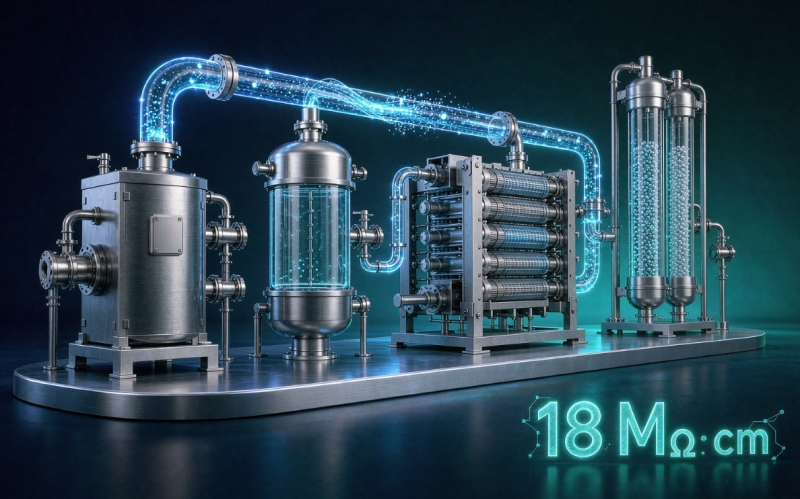
When it comes to making ultrapure water, you can't really avoid that 18 MΩ·cm number.
It refers to resistivity—water only counts as 'pure' when the ions that can conduct electricity are low enough.
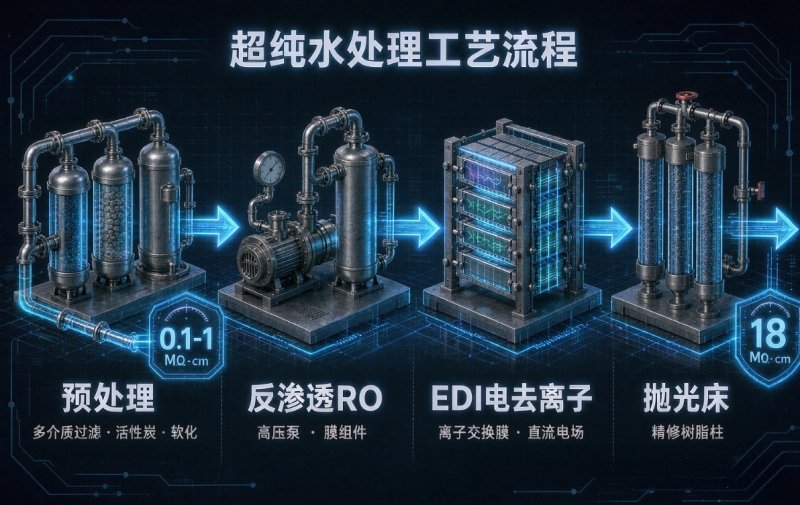
Getting from tap water to that point relies on a whole chain of interconnected processes: pretreatment, reverse osmosis, EDI, and polishing beds. Today, let's follow that chain and see what each stage is actually doing, and why you can't skip it.
1. Pretreatment: It's not about desalination, it's about protecting the membrane
When raw water comes in, the first thing isn’t desalination—it’s keeping things that could damage the equipment out.
If you don’t remove suspended solids, residual chlorine, hardness, and organics, the RO membrane downstream will quickly get fouled, oxidized, and scaled.
Multi-media filtration, activated carbon adsorption, softening, or adding anti-scalant—exactly which steps you take depends on the raw water quality report.
If you do this step well, the RO membrane can run steadily.
2. Reverse Osmosis (RO): Pushing most ions away
Under pressure, water molecules pass through the RO membrane, while dissolved salts, organics, and microorganisms stay on the concentrated water side. The produced water can reach a resistivity of 0.1–1 MΩ·cm, much cleaner than tap water, but still far from the 18 MΩ·cm ideal. RO has a clear role: supply qualified feed water to EDI. The steadier the RO output, the lighter the load on the EDI.
3. EDI: The core of the whole system
EDI, or Electrodeionization, combines electrodialysis and ion exchange. The equipment has ion exchange membranes, mixed resins, electrodes, and a power source. A direct current electric field drives ions in the right direction: cations move toward the cathode, anions toward the anode. Ion exchange membranes separate them selectively, and mixed resins capture the remaining ions.
The best thing about EDI is that the resins can 'regenerate' themselves using the electric field — the field pushes the ions away while also removing those stuck on the resin. The resin stays in working condition continuously, without the need for periodic acid-base regeneration like traditional mixed beds, so continuous water production is possible without chemicals. RO removes most of the ions first, and EDI cleans up the rest; the two work in tandem.
4. Polishing Bed: Final "Finishing Touch"
After EDI, the water quality is already pretty good, but to stabilize it at 18 MΩ·cm, you need to add a polishing bed.
The polishing bed uses high-strength cation resin, specifically to replace trace cations remaining in the water. It's the final "finishing touch," usually placed after the EDI and before the point-of-use water, giving already very pure water an extra boost.
5. Looking at it as a sequence: Step-by-step load reduction, final finishing
If you connect these four steps in a line, the logic becomes clear:
Pre-treatment protects the membrane, RO removes salts, EDI drives off ions with continuous resin regeneration, and the polishing bed fine-tunes it to 18 MΩ·cm.
The water output from each stage is the input requirement for the next stage. So when designing, you have to work backwards to make sure the configuration makes sense.
6. Where it's used: from chips to labs
This set of processes is used really widely: electronics, semiconductors, power, electroplating, biopharmaceuticals, daily chemicals, food, paper, labs, chemicals, steel—basically, anywhere that requires high water purity.
Different industries have different requirements; some need 18 MΩ·cm, some 15 MΩ·cm is enough. The setup depends on the water usage points, there’s no one-size-fits-all answer.