
Marketing Hotline:
(+86)0532-88988868
(+86)0532-88988868
Integrated sewage treatment equipment combines a primary sedimentation tank, first and second-stage contact oxidation tanks, a secondary sedimentation tank, and a sludge tank into one unit. In the first and second-stage contact oxidation tanks, aeration is applied, effectively combining the contact oxidation method with the activated sludge method. This setup not only takes advantage of both methods but also overcomes their shortcomings, further improving the level of sewage treatment.
This integrated sewage treatment equipment can be widely used for domestic sewage in residential communities, villages, towns, office buildings, shopping malls, hotels, restaurants, sanatoriums, government offices, schools, military units, hospitals, highways, railways, factories, mines, and tourist areas. It’s also suitable for small to medium-scale industrial organic wastewater from slaughterhouses, seafood processing, food production, and similar sources. Sewage treated with this equipment meets the national first-grade B standard for comprehensive sewage discharge.
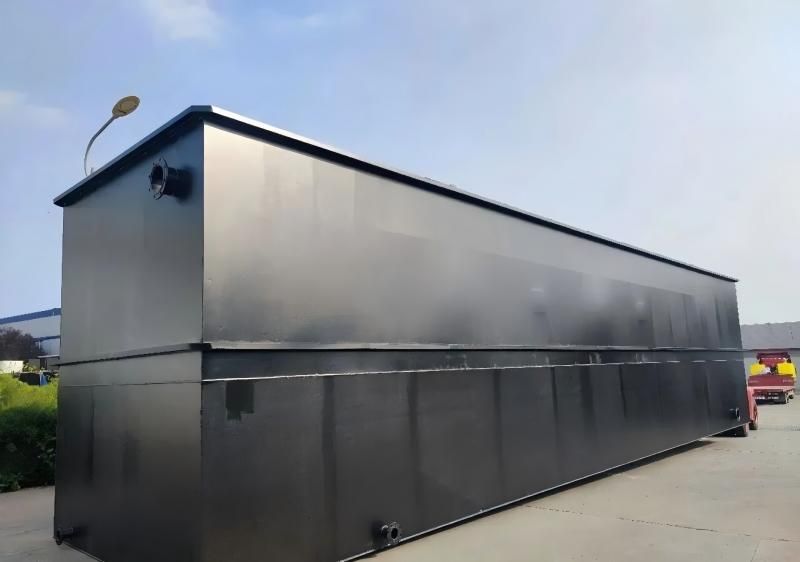
One. Integrated Wastewater Treatment Equipment Installation and Commissioning
1. Prepare the foundation according to the installation and foundation drawings, using the floor plan dimensions as the standard, and ensure the concrete base is well done.
2. During installation, pipes must be connected strictly according to the installation drawings. Once the equipment is in place, use rubber gaskets to secure the pipe connections and prevent leaks. Note that the equipment installation and piping diagrams follow standard connections and layout; if the user wants a different layout, it must be requested when placing the order.
3. When installing and connecting pipelines, it should be planned when the equipment is in place. When the equipment is positioned, follow the equipment’s weight as per the manual, match the crane’s capacity, and place the equipment according to the on-site reference diagram. The position and direction of the cylinders must be correct, and the spacing between them must be accurate.
4. Once the equipment installation is properly completed, you can fill the soil around the equipment and into the gaps, compact it, and level the ground. When backfilling, pay attention to:
(1) The equipment manhole cover should be about 50mm above the ground;
(2) Do not let soil block the air inlet on the manhole cover.
5. After installation, the equipment must be securely fixed to the base floor to prevent it from floating or moving. At the same time, sewage should be filled into the equipment to at least 70% capacity to avoid it floating. Also, check all the pipes for any leaks.
6. Connect the control lines from the electric control cabinet to the equipment. When wiring, pay attention to the rotation of the fans and the submersible sewage pump motors. The control cabinet should be placed in a ventilated, dry area—generally, it shouldn’t be placed outdoors. It needs to be protected from sunlight and rain to prevent electric leakage or damage to the control board.
7. Connect the control circuits for the fans and pumps, and make sure the rotation direction of the fans and pumps is correct.
Two. Integrated wastewater treatment equipment has the advantage of being easy to use. To ensure it runs well, you need to pay attention to a few things:
1. Equipment foundation
First, you need to know whether your equipment will be placed above ground or underground.
If your equipment is going to be above ground, you need to prepare a concrete platform that matches the shape of your equipment as a foundation. The foundation's load-bearing capacity must be greater than 4T/㎡, and it needs to be level and flat.
If your equipment is going to be buried underground, the foundation height must be less than or equal to the standard height of the equipment, and it must ensure no water accumulation on rainy days. The foundation is generally made of plain concrete.
2. Overall Equipment Installation
Integrated sewage treatment equipment generally has two sets of tanks. One set is a reinforced concrete structure, and the other is a steel structure. The civil engineering design drawings for both are provided by the equipment company. Typically, the actual excavation width of the pit is required to be larger than what is in the design. After installation, you need to check whether the tanks are leaking before backfilling.
3. Equipment Commissioning
Once installation is complete, the equipment commissioning can begin. This work is usually done by the equipment company. To make commissioning easier, you can introduce bacterial cultures and acclimate them to meet the design requirements.
4. Follow-up maintenance and care
When using an integrated sewage treatment device, you should regularly check and maintain the parts that are prone to damage, such as the fan and water pump areas. Check whether screws are loose or misplaced in various parts, and maintain the equipment in time.
Three. For daily use, integrated domestic sewage treatment equipment should have a regular maintenance schedule.
Regularly check for loose screws on the fan and pump, the tightness of the packing box, the temperature of the bearings, and the quality and amount of lubricating oil to ensure all parts are working properly. Also, check the dosing and remaining amount of disinfectant, adjust the dosage if necessary, and replenish the disinfectant. Regular maintenance and upkeep of the equipment is important.
Maintenance Requirements for Integrated Domestic Sewage Treatment Equipment:
1. Organization: Keep items, workpieces, and accessories neatly arranged; ensure safety protection devices are complete, and pipelines and wiring are intact.
2. Lubrication: Add and replace oil on time, using the appropriate quality; keep oil cans, oil guns, oil cups, oil felts, and oil lines clean; oil indicators should be bright and oil passages unobstructed.
3. Safety: Follow the rules of assigning specific people to specific machines and shift handovers; understand the equipment structure and strictly follow operating procedures; use the equipment reasonably, take good care of it, and prevent accidents.
4. Cleanliness: Keep domestic sewage treatment equipment clean inside and out; sliding surfaces, screws, gears, and racks should be free of oil stains and damage; no leaks of oil, water, air, or electricity; clean up chips and waste thoroughly.