Marketing Hotline:
(+86)0532-88988868
(+86)0532-88988868
1. Equipment Overview
1.1 Working Principle
The PT-type fully automatic dosing device is equipment for continuously preparing and dosing polymer solutions. It continuously and efficiently carries out the chemical reaction and mixing of polymers according to the required chemical concentration, producing a homogeneous active polymer solution. This solution is then delivered to the dosing point or a designated system through the dosing pump. It is mainly used in situations like municipal water treatment and wastewater plants where polymer solutions are needed.
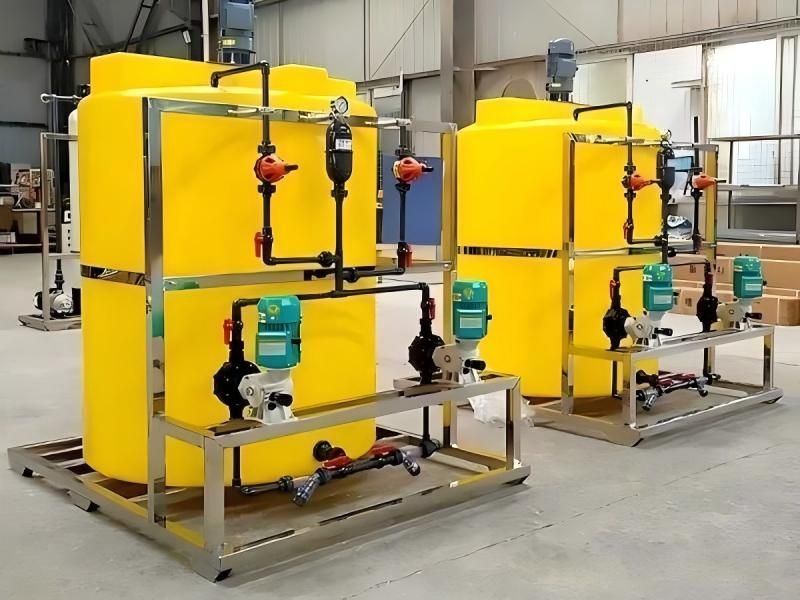
The working process is mainly divided into the following steps:
(1) Fill the hopper with enough dry powder, and start the dry feeder to convey the dry powder from the hopper to the pre-wetting device. At the same time, open the solenoid valve on the water inlet pipe. The dry powder is wetted in the pre-wetting device and then flows by gravity into the mixing tank for stirring and mixing.
(2) The initially stirred and mixed solution flows through the overflow weir into the homogenization and maturation tank for further stirring and combining. After effective, gentle low-speed stirring for a certain period, the solution meets the requirements of homogenization, maturation, and activation; it then flows through the overflow weir into the solution storage tank, ready for dosing.
(3) When the solution storage tank is full, the level switch sends a signal, and the dry feeder and solenoid valve automatically shut off.
(4) The dosing pump starts, the solenoid valve opens, and the solution is added to the required equipment.
(5) When the level in the solution storage tank reaches the set low level, the level switch sends a signal, and the device automatically repeats steps (1)、 (2)and (3) to ensure there is enough solution in the storage tank.
1.2 Main Components
It mainly consists of a dosing device, a dissolving device, a water supply system, and a control system:
1.2.1 Dosing Device
It is made up of a stainless steel hopper, a screw conveyor, an electric heater, and other components.
(1) Stainless steel hopper effective volume: 60L, which can meet long-term usage needs. The hopper is equipped with a sight glass for manual observation of the material level. The level meter can automatically monitor the material level and also trigger an alarm.
(2) The screw conveyor is powered by a worm gear reducer that drives a high-precision screw. The reducer is lightweight, runs smoothly, and has high efficiency. The high-precision screw can fully meet the user’s dosing requirements.
(3) An electric heater is installed in the conveyor discharge pipe to prevent the dry powder in the pipe from absorbing moisture, forming clumps, and causing the pipe to get blocked.
1.2.2 Solution Preparation Device
It usually consists of a pre-wetting device, a stainless steel tank, and two mixers.
(1) The pre-wetting device uses a stainless steel swirl hopper, where water enters tangentially, creating a swirling water curtain inside the hopper to pre-wet and mix the dry powder, which then goes into the prefabricated mixing tank.
(2) The stainless steel tank has a three-tank structure: the prefabricated mixing tank, the homogenization and curing tank, and the solution storage tank. Each tank has baffles and overflow weirs. During solution preparation, the liquid flows from the bottom of the baffles over the weir to the next tank, which helps prevent raw liquid from short-circuiting into the curing solution. The tank is fully enclosed with a stainless steel lid that has a handle. The prefabricated mixing tank also has a built-in overflow pipe to prevent overflow if the liquid level exceeds the high-level setting (fault). All three tanks have outlet pipes with manual ball valves, and these pipes are connected: one end serves as the dosing pipe, and the other as the drain pipe.
(3) Two mixers are installed in the prefabricated mixing tank and the homogenizing maturation tank. The agitators have a unique structure and appropriate speed, which can ensure the solution is homogenized without damaging the polymer chains.
1.2.3 Water Supply System
It consists of UPVC pipes, manual ball valves, filters, pressure gauges, solenoid valves, stop valves, and rotameters.
(1) Filters are used to block impurities in the water to protect the solenoid valves.
(2) The pressure gauge is installed after the filter to show the pressure. If the pressure is too low, it indicates that the filter is clogged and needs to be cleaned.
(3) The solenoid valve receives electrical signals to allow water in, enabling automatic water intake.
(4) The rotameter is used to display the water flow.
(5) The stop valve is used to adjust the water flow; it's convenient and stable to use.
1.2.4 Control System
It consists of an electrical control cabinet and a level switch. The electrical control cabinet uses Schneider Electric components.
1.3 Scope of Application
(1) Adding coagulants, flocculants, disinfectants, and acid-base solutions in water treatment;
(2) Adding scale inhibitors and so on in cooling water and circulating water;
(3) Adding acid-base solutions and other solutions in chemical and textile dyeing processes.
To help customers better understand the configuration, technical parameters, and features of products available online in the store, and to make equipment selection more convenient and quicker, the following equipment selection guide is provided.
2. What types of dosing equipment are there?
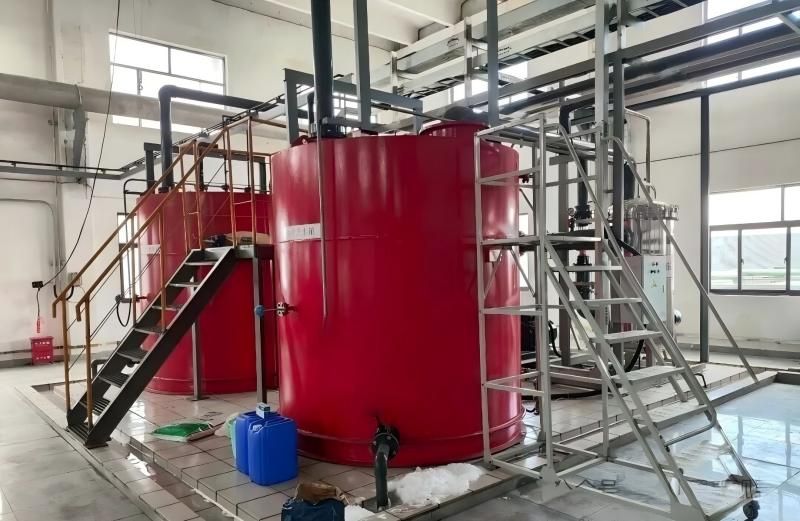
There are two types of dosing equipment:
(1) Metering pumps
Using metering pumps is simple and reliable, and they are commonly used for dosing. There are many models of metering pumps produced in China, enough to meet dosing needs. Usually, large water plants use metering pumps to inject a set amount of chemicals into the water.
(2) Orifice dosing equipment
In orifice dosing equipment, the liquid level is kept constant by a float. At a constant level, the flow rate from a nozzle (also called a tube nozzle) of a certain diameter, or from an orifice plate opened to a certain degree, is constant. When you need to adjust the dosing amount, you can change the nozzle or adjust the size of the orifice.
3. Chemical Dosing Equipment and Application Precautions
To ensure treatment effectiveness, no matter what type of coagulant or dosing device is used, the following points should be noted when operating dosing equipment:
(1) Ensure all equipment is in good working order and that there is enough chemical.
(2) Calibrate the dosing device to make sure the chemical dosage meets process requirements.
(3) Ensure the chemical meets the quality standards required by the process.
(4) Regularly test the raw wastewater quality to make sure the dosing matches changes in water quality and meets discharge requirements.
(5) During shift changes, clearly report the concentration in the chemical storage and dosing tanks.
(6) Frequently check the dosing pipes to prevent blockages or breaks and ensure the pumping system works properly.
(7) If there is a flow interruption, check and repair it as soon as possible.