
Marketing Hotline:
(+86)0532-88988868
(+86)0532-88988868
Ozone (O3) wastewater treatment technology was applied to water treatment in 1905. With advances in related technologies and the reduction in the cost of ozonation, it is generally considered a promising method for water treatment.
Ozone has very strong oxidizing properties, and its oxidation mechanism has not yet been conclusively determined. It is generally believed that the main effect comes from OH radicals generated by ozone decomposition. OH radicals are the most reactive oxidants known to occur in water and can easily oxidize various types of organic matter through basic reactions. OH radicals can also react with other substances, such as benzene derivatives, to form secondary oxidizing species. They can also oxidize carbonate or bicarbonate ions into carbonate or bicarbonate that can act as tertiary oxidants, and ozone molecules can decompose into hydroperoxide radicals.
Main Processes of Ozone Treatment
There are many types of ozone (O3) water treatment processes, mainly including:
1. Ozone (O3) with biologically active carbon,
2. Ozone (O3) coagulation,
3. Ozone (O3) with activated carbon adsorption,
4. Ozone (O3) with activated sludge,
5. Ozone (O3) membrane treatment,
6. Ozone (O3) ultrasonic method.
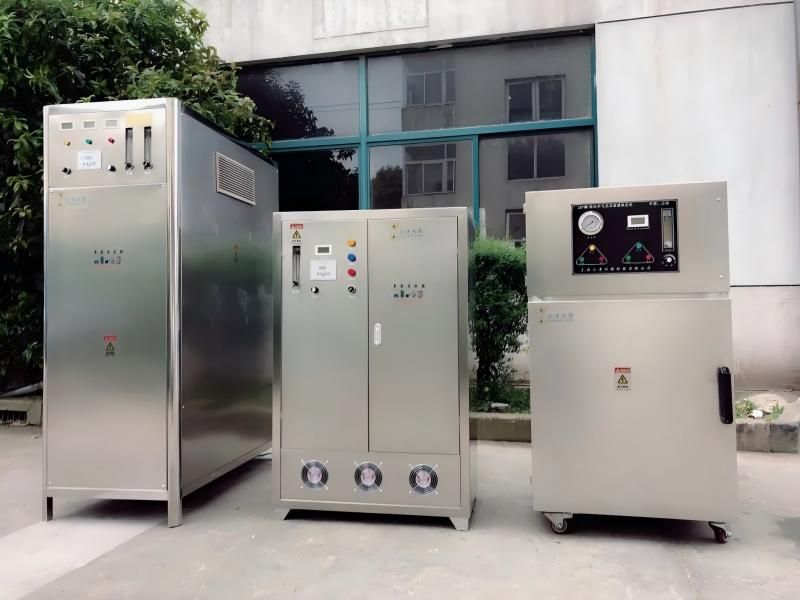
Ozone (O3) biological activated carbon method mainly works like this: first, ozone is added to the water. Its strong oxidizing power breaks complex organic molecules into smaller ones, making them easier to biodegrade, and it also increases the dissolved oxygen in the water. Then the water enters the biological activated carbon unit, where the easily degradable organics are concentrated by the activated carbon and decomposed into CO2 and H2O by aerobic microorganisms. The feature of this process is that ozone pretreatment improves the biodegradability of wastewater, and concentrating the organics along with increased oxygen speeds up the biochemical reactions; the biodegradation of organics on the activated carbon can also restore the carbon's adsorption capacity.
Ozone (O3) coagulation is based on ozone's strong ability to break down hydrophilic substances. When hydrophilic substances turn hydrophobic, the coagulation and precipitation effect is greatly improved.
Ozone (O3) activated carbon adsorption refers to this: because activated carbon has tiny micropores, it limits adsorption of large molecules. Ozone can break down the molecular structure into smaller molecules, increasing the adsorption capacity of the activated carbon.
The role of ozone (O3) in the activated sludge method is similar to that of biologically active carbon, aiming to improve the biodegradability of wastewater.
Ozone (O3) membrane treatment is commonly used as a post-treatment for ultrafiltration (UF).
Increasing the amount of ozone (O3) can deepen the biological reaction and improve the removal rate of complex organic matter.
Ozone unit treatment mainly uses catalytic oxidation methods, such as alkaline catalytic oxidation, photocatalytic oxidation, and heterogeneous catalytic oxidation. Specific treatment methods include:
① Ozone (O3)/H2O2,
② Ozone (O3)/UV,
③ Ozone (O3)/solid catalysts (metals and their oxides, activated carbon, etc.).
From the reaction mechanism perspective:
① It's base-catalyzed ozonation,
② It's photocatalytic ozonation,
③ It's heterogeneous catalytic ozonation.
The pathway for base-catalyzed ozonation is: catalyzed by OH-, generating -OH radicals, which then oxidize and break down organic matter. The formation of -OH radicals goes like this: (O3) OH → O2 HO2, O3 O2 → O3 O2, O3 H → HO3 → OH O2
Photocatalytic oxidation uses ultraviolet light as the energy source and ozone as the oxidant, employing the reactive secondary oxidants generated when ozone is exposed to UV light to oxidize organic compounds. Gary, Peyton, and others believe that ozone photolysis first produces H2O2, which under UV light generates -OH radicals, entering an OH radical cycle: O2 - O3 → O3 O2, O3 H → HO3 → OH O2.
When using photocatalytic ozonation to treat hard-to-degrade organic wastewater, some of the hard-to-degrade organics are excited under UV light, reaching a higher energy state, and react with OH radicals through hydroxylation to form new substances that are easier to biodegrade.
Heterogeneous catalytic ozonation is a new technology that has emerged in recent years. Its metal catalysts aim to promote the decomposition of ozone (O3) to produce reactive -OH radicals and enhance oxidation. Common catalysts include CuO, Fe2O3, NiO, TiO2, and Mn.