
Marketing Hotline:
(+86)0532-88988868
(+86)0532-88988868
Groundwater is water stored in the pores of geological formations below the unsaturated zone, including rock pores, fractures, and caves. Due to variations in the areas through which groundwater flows, there are often occurrences of excessive levels of certain substances.
Pollution sources:
① Domestic sewage and household waste can cause increases in the total dissolved solids, total hardness, nitrate, and chloride content of groundwater, and sometimes lead to pathogen contamination.
② Industrial wastewater and industrial waste can increase the concentrations of organic and inorganic compounds in groundwater.
③ The use of chemical fertilizers and manure in agriculture can lead to widespread increases in groundwater nitrate levels. Pesticide pollution of groundwater is relatively minor and mostly affects shallow layers. Agricultural cultivation activities can promote the oxidation of organic matter in the soil, such as the conversion of organic nitrogen to inorganic nitrogen (mainly nitrate nitrogen), which enters groundwater through percolating water. Natural saline water can also lead to salinization of natural freshwater.
Characteristics of Groundwater with Excessive Iron:
1. Well water turns yellow; clear well water becomes light yellow in a few hours to a day when in a pool.
2. Well water has yellow sediment; after a few days, yellow iron mud settles at the bottom of the pool, and the pool walls turn yellow.
3. Water turns slightly yellow after boiling; the higher the iron content, the deeper the yellow color.
4. Well water has an oil film; an oil film floats on the water surface.
5. Well water has a fishy smell; freshly drawn well water has a noticeable iron odor.
6. Manganese has a weaker coloring ability; if iron is also excessive, the coloring effect of manganese is not noticeable.
7. When manganese is excessive alone, it can turn pool walls and the ground where water is used black and cause delamination.
8. Washing clothes can darken their color.
Characteristics of groundwater with excessive manganese:
1. Manganese has weak staining ability, and when iron is also excessive, the staining effect of manganese is not visible;
2. When manganese is excessive alone, it can turn the walls of pools and the floors where water is used black, and peeling may occur;
3. Washing clothes will make them darker in color.
Characteristics of groundwater with excessive hardness:
1. After boiling, white chunks appear at the bottom of the kettle;
2. Pipes get clogged, and water flow is poor;
3. Cleaning furniture leaves white residue.
For the above groundwater contamination issues, water treatment equipment such as groundwater iron and manganese removal devices can be used. After treatment, the iron, manganese, and hardness content of the groundwater can all reach normal standards.
Reasons for Excessive Total Hardness of Groundwater
Issue One:
Why is the total dissolved solids in groundwater exceeding the standard? Groundwater refers to water stored in the voids of rocks below the surface. In a narrow sense, it refers to water in the saturated aquifers below the groundwater table. According to the national standard 'Hydrogeological Terms' (GB/T 14157-93), groundwater refers to all forms of gravity water buried below the ground surface.
Total Dissolved Solids:
Formerly called total mineralization. It refers to the total amount of dissolved components in water, including the total amount of various ions, molecules, and compounds dissolved in water, but excluding suspended solids and dissolved gases.
Mineralization is expressed in grams per liter. Generally, to determine mineralization, one liter of water is heated to 105–110°C until all the water evaporates, and the remaining residue mass is the mineralization of the water. It can also be determined by summing the amounts of various ions analyzed in the water and then subtracting half of the HCO₃ content. Groundwater is generally classified according to mineralization (M) as follows: fresh water, M ≤ 0.05 grams per liter. The main types of salts in groundwater often change with the increase or decrease of mineralization.
Excessive total dissolved solids in groundwater indicate that the content of total dissolved solids in the groundwater is relatively high and exceeds the required standard. For example: slightly brackish water, M = 1–3 grams per liter.
Question 2: What are the harms of hard water?
1. Long-term consumption of hard water can lead to diseases in the cardiovascular, nervous, urinary, and hematopoietic systems.
2. Boiled hard water tastes bad and often causes scale buildup at the bottom of the kettle, seriously affecting the taste and quality of food.
3. When bathing, hair and skin often feel dry and tight, which damages the skin and accelerates aging.
4. When washing clothes, detergent is wasted, and clothes are hard to clean. Washed clothes become brittle and stiff, and retain the smell of detergent.
5. Water stains and spots often appear on tableware and sanitary ware, requiring frequent cleaning. Limescale may also appear in sinks and even on walls.
6. The efficiency of water heaters decreases with time due to accumulated scale, which wastes energy and creates safety hazards.
Question 3: Is groundwater high in hardness?
----Yes. Because groundwater stays underground for a long time, it dissolves a lot of minerals, so its hardness is relatively high.
Question 4: How to soften groundwater when the total hardness is around 10,000?
Try calcium and magnesium ion removers.
For example, use anionic polyacrylamide (PAM) to remove calcium and magnesium.
Currently, the relatively mature methods to separate and remove sulfate mainly include the barium chloride method, calcium chloride method, freezing method, barium carbonate method, ion exchange method, and membrane separation method.
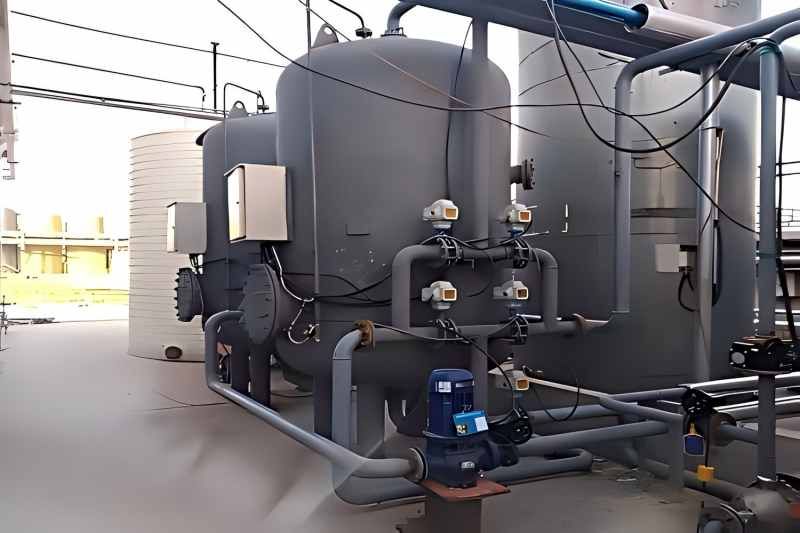
Iron and manganese removal filters are also called manganese sand filters.
Iron and manganese removal filters are common equipment for groundwater treatment. Iron and manganese almost always coexist in groundwater, especially in northern China and areas rich in iron and manganese ores. For various industrial water uses such as paper making, textiles, printing and dyeing, leather processing, and other production waters, they can seriously affect product quality. When the water contains a high amount of iron, it has an iron taste that affects the water's flavor. For drinking water, China’s "Standards for Drinking Water Quality" (GB5749-85) stipulates that the iron content should be ≤0.3 mg/L and the manganese content ≤0.1 mg/L. Raw water that exceeds these standards must undergo iron and manganese removal treatment. Long-term consumption of water with excessive iron and manganese content can also seriously affect health.
1. Methods for Removing Iron and Manganese
Water with excessively high iron and manganese content generally uses oxidation to convert dissolved ferrous iron or manganous manganese into insoluble ferric iron or manganic manganese compounds, respectively. Adsorption filtration with a manganese sand filter can remove iron and manganese. The chemical reactions that occur during the oxidation process are as follows:
4Fe²⁺ + O₂ + 10H₂O = 4Fe(OH)₃ + 8H⁺
2Mn²⁺ + O₂ + 2H₂O = 2MnO₂ + 4H⁺
II. Methods of Iron and Manganese Oxidation
1. Jet aeration: Generally used in projects with small flow rates and low iron and manganese content. The advantage is lower cost.
2. Nikuni pump: Similar in principle to the jet aerator, mainly through the large circulation of the Nikuni pump to draw in air for oxidation.
3. Tower aeration: Generally used in projects with large flow rates and high iron and manganese content. Oxygen provided by a fan fully contacts the water inside the tower. The tower is filled with multi-faceted hollow spheres, increasing the water's specific surface area.
4. Blower aeration: Generally used in large flow systems such as tap water, with high iron and manganese content. It has high construction costs and high operating costs.
III. Structure of Iron and Manganese Removal Filter
It is generally made of carbon steel or stainless steel 304, with an internal epoxy resin coating or a natural rubber lining for corrosion protection. The water distribution system includes basket-type distribution, dome-plate distribution underneath, stainless steel pipe distribution, and flat-plate distribution. The distribution caps can be ABS mushroom-shaped or spiral-wire column type. Under the pipe distribution and dome-plate distribution, there is a padding layer composed of large pebbles or large quartz sand, mainly because they have large voids, low resistance, and facilitate water collection and backwashing.
Scope of Application
Mainly used for the treatment of food, beverages, paper making, brewing industries, water with excessive iron content, removal of iron from groundwater and well water for drinking, geothermal projects, and swimming pool circulation water.
Product Features
The quality of the treated water is stable, with high efficiency in removing iron and manganese, and low operation and maintenance costs. Compared with the natural oxidation iron removal method, it does not require large reaction and precipitation structures and occupies a small area.
Iron and Manganese Filter Technical Parameters
1. Inlet Water Quality
Iron content: ≤20 mg/L
Manganese content: ≤3 mg/L
Inlet turbidity: <15 mg/L
Alkalinity: ≤2 mg/L
pH value: >5.5
Water temperature: 6–10°C
Working pressure: <0.4 MPa
Working temperature: normal temperature
3. Operating Parameters
Filtering Speed: 7–15 m/h
Filter Media Layer Height: 800–1200 mm
Compressed Air Pressure: 1–2 Kg/cm²
Backwash Compressed Air Volume: 18–25 L/m²·s
Backwash Time: 5–10 minutes
Backwash Intensity: 15 L/m²·s (single layer), 12 L/m²·s (double layer)
Working Principle
The iron and manganese removal filter uses oxidation to convert ferrous iron ions and manganese ions in the water into ferric iron ions and manganese ions, which are then removed through adsorption and filtration to reduce the iron and manganese content in the water.
The iron and manganese removal filter employs well pump residual pressure jet suction, tubular dissolved oxygen mixing, disc spray water degassing, and filter bed contact oxidation filtration processes. It relocates the traditional external aeration oxidation into the equipment itself. The equipment can operate solely on the residual pressure from the well pump, offering significant advantages such as low energy consumption, simple process, stable performance, and reduced overall investment.
1. Aeration method: On one hand, it increases the dissolved oxygen in water; on the other hand, it removes CO2 to raise the water's pH, causing divalent iron to oxidize into trivalent iron and precipitate, which is then filtered.
2. Filtration: On one hand, it removes the flocs formed by trivalent iron; on the other hand, it catalyzes the oxidation of most of the remaining unoxidized divalent iron and utilizes the ion exchange action of hydroxyl ions to achieve iron removal. The iron sludge after filtration can be recovered and reused.
The filter media include quartz sand and natural manganese sand. The former is used for raw water with an iron content below 4 mg/L and a pH above 6.8; the latter is suitable for raw water with an iron content below 20 mg/L and a pH above 6.
The principle of manganese removal is the same as that for divalent iron removal.
IV. Instructions for Selecting Iron and Manganese Removal Filters
1. Equipment Selection
① Depending on the water quality, a single-stage or two-stage treatment system can be chosen, and depending on the water volume, a single unit or multiple units in parallel can be used.
② The process flow for iron and manganese removal should be determined based on the following conditions:
a. When the raw water iron content ≤ 10 mg/L and manganese content ≤ 0.5 mg/L, a single-stage treatment system is used; when the iron content < 20 mg/L or manganese content > 1 mg/L, a two-stage iron and manganese removal system is used.
b. When the raw water iron content ≤ 2.0 mg/L and manganese content ≤ 1.5 mg/L, the following can be used: raw water aeration—single-stage filtration to remove iron and manganese.
c. When the raw water iron or manganese content exceeds the above values, it should be determined by testing; the following can be used: raw water aeration—oxidation—primary filtration to remove iron—secondary filtration to remove manganese.
d. When iron removal is affected by silicates, it should be determined by testing. If necessary, the following can be used: raw water aeration—primary filtration to remove iron (contact oxidation)—aeration—secondary filtration to remove manganese.
③ The pH value of water before the manganese removal filter should preferably be above 7.5, and the iron content of water before the secondary manganese removal filter should preferably be controlled below 0.5 mg/L.